PLANTWATCH AI · GLOBAL PLANT PATHOLOGY

INDEX No. 04 — HERBARIUM16 CROPS

Plant Types & Crop Library

Every crop carries its own disease profile. This library pairs a field photograph with the botanical name, family, soil and season requirements, and the specific symptoms worth scouting for — a study reference for agriculture students, a decision aid for farmers, and a quick lookup for pathologists.

Tomato (Solanum lycopersicum) growing in the field
VegetableSolanaceae

Tomato

Solanum lycopersicum

The most disease-prone crop most growers ever plant. Tomato hosts fungal, bacterial, viral and nutritional disorders at once, which is why accurate identification matters more here than anywhere else.

Grown in
India, Nigeria, Ghana, Kenya, Brazil, Mediterranean
Season
Warm season, 90–120 days to first harvest
Soil & pH
Well-drained loam, pH 6.0–6.8, high calcium demand

What to scout for

  • Dark greasy lesions after cool wet nights — late blight
  • Lower leaves speckled and yellowing upward — Septoria leaf spot
  • Whole plant wilting with green leaves attached — bacterial wilt
  • Blossom-end rot from calcium uptake failure, not a pathogen
Maize / Corn (Zea mays) growing in the field
CerealPoaceae

Maize / Corn

Zea mays

Africa's staple cereal and the crop where nitrogen management decides yield. Most 'disease' calls on maize turn out to be nutrient stress or fall armyworm damage rather than a pathogen.

Grown in
Nigeria, Kenya, Ghana, Tanzania, India, Mexico, USA
Season
Rain-fed, 90–140 days depending on variety
Soil & pH
Deep fertile loam, pH 5.8–7.0, very high nitrogen demand

What to scout for

  • Inverted V-shaped yellowing from the leaf tip — classic nitrogen deficiency
  • Long grey-green cigar lesions — northern leaf blight
  • Rust pustules that rub off orange on the thumb
  • Ragged windowpane feeding in the whorl — fall armyworm, not disease
Cassava (Manihot esculenta) growing in the field
Root & TuberEuphorbiaceae

Cassava

Manihot esculenta

The food-security backbone of West and Central Africa. Cassava's biggest threat is viral — cassava mosaic disease spreads through cuttings, so the single highest-value intervention is clean planting material.

Grown in
Nigeria, Ghana, DR Congo, Tanzania, Indonesia, Brazil
Season
8–18 months, drought tolerant
Soil & pH
Light sandy loam, pH 5.5–6.5, tolerates low fertility

What to scout for

  • Yellow-green mottling and distorted leaflets — cassava mosaic disease
  • Brown streaking inside the root — cassava brown streak
  • White fluffy insects on leaf undersides — whitefly, the virus vector
  • Stunting inherited from infected stem cuttings
Rice (Oryza sativa) growing in the field
CerealPoaceae

Rice

Oryza sativa

Half the world eats rice daily. Blast and bacterial leaf blight are the two diseases that move fastest under the humid, dense canopies that irrigated rice creates.

Grown in
India, Bangladesh, Indonesia, Vietnam, China, Nigeria
Season
Wet season, 100–150 days
Soil & pH
Heavy clay that holds water, pH 5.5–6.5

What to scout for

  • Diamond-shaped lesions with grey centres — rice blast
  • Water-soaked stripes running down from leaf tips — bacterial leaf blight
  • Rusty-brown speckling on older leaves — brown spot from potassium stress
  • Empty panicles at harvest despite healthy foliage
Wheat (Triticum aestivum) growing in the field
CerealPoaceae

Wheat

Triticum aestivum

The rust crop. Stem, leaf and stripe rusts evolve into new races faster than breeders can release varieties, which makes weekly scouting during stem elongation non-negotiable.

Grown in
India, China, Russia, Ethiopia, Germany, Sweden
Season
Cool season, 110–150 days
Soil & pH
Well-drained loam, pH 6.0–7.5

What to scout for

  • Orange-brown pustules in rows along the leaf — leaf rust
  • Yellow stripe pustules between veins — stripe rust
  • Powdery white colonies at the base of the canopy
  • Pale, thin stands from nitrogen shortfall at tillering
Potato (Solanum tuberosum) growing in the field
Root & TuberSolanaceae

Potato

Solanum tuberosum

Late blight's original host. A potato crop can go from first lesion to total loss in ten days, so protectant spraying starts before symptoms appear, not after.

Grown in
India, China, Kenya, Russia, Germany, Peru
Season
Cool season, 90–120 days
Soil & pH
Loose, well-drained sandy loam, pH 5.0–6.0

What to scout for

  • Water-soaked dark blotches with white sporulation underneath
  • Firm brown rot when a tuber is cut open
  • Rolled, leathery upper leaves — leafroll virus
  • Blackleg softening at the stem base after wet weather
Banana & Plantain (Musa spp.) growing in the field
FruitMusaceae

Banana & Plantain

Musa spp.

Black Sigatoka and Fusarium wilt (Panama disease) are the two threats that decide whether a plantation survives a decade. Both are managed through sanitation and variety choice long before any spray.

Grown in
Uganda, Ghana, Nigeria, India, Philippines, Ecuador
Season
Perennial, 9–12 months to first bunch
Soil & pH
Deep, rich, well-drained soil, pH 5.5–7.0, heavy potassium demand

What to scout for

  • Narrow dark streaks widening into grey blotches — black Sigatoka
  • Yellowing that starts on the oldest leaves and collapses the skirt — Fusarium wilt
  • Brown vascular rings when the pseudostem is cut
  • Marginal leaf scorch from potassium deficiency
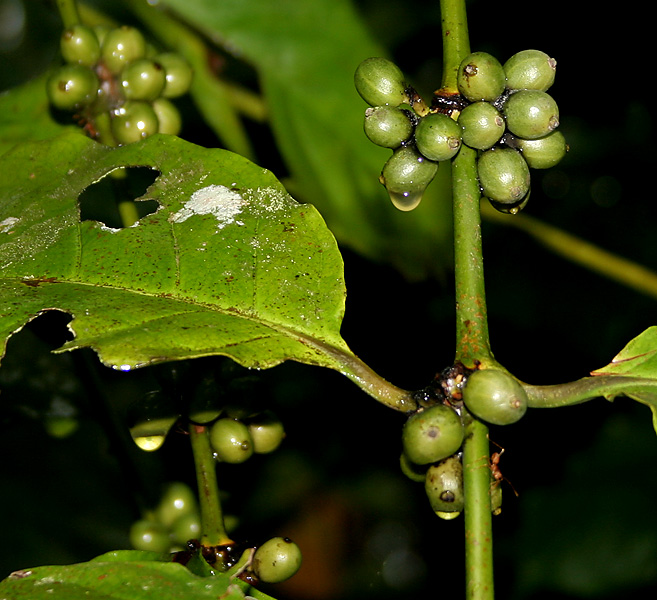
Coffee (Coffea arabica / canephora) growing in the field
Cash CropRubiaceae

Coffee

Coffea arabica / canephora

Coffee leaf rust (Hemileia vastatrix) has reshaped entire national economies. Copper-based preventive programmes through the rains, plus rust-tolerant varieties, remain the core defence.

Grown in
Ethiopia, Kenya, Uganda, Brazil, Colombia, Vietnam
Season
Perennial, 3–4 years to first commercial crop
Soil & pH
Volcanic loam, pH 5.0–6.0, shade-tolerant

What to scout for

  • Yellow-orange powdery patches on leaf undersides — coffee leaf rust
  • Sunken dark lesions on green berries — coffee berry disease
  • Small round exit holes in cherries — coffee berry borer
  • Sudden defoliation after the rains, then a collapsed harvest
Cocoa (Theobroma cacao) growing in the field
Cash CropMalvaceae

Cocoa

Theobroma cacao

Ghana and Côte d'Ivoire grow most of the world's cocoa, and black pod disease takes a fifth of it every year. Weekly pod removal during the rains is worth more than any single spray.

Grown in
Côte d'Ivoire, Ghana, Nigeria, Cameroon, Indonesia
Season
Perennial, two harvest peaks per year
Soil & pH
Deep, moist, well-drained forest soil, pH 6.0–7.0, needs shade

What to scout for

  • Brown spreading rot on pods — black pod (Phytophthora)
  • Swollen shoots and red vein banding — swollen shoot virus
  • Mealybugs on the flower cushions, the virus vector
  • Sooty mould following heavy mealybug activity
Pepper & Chilli (Capsicum annuum) growing in the field
VegetableSolanaceae

Pepper & Chilli

Capsicum annuum

High-value, high-risk. Pepper is hit hardest by anthracnose in the rains and by aphid-borne viruses in the dry season, so the calendar decides which enemy you are managing.

Grown in
India, Nigeria, Ghana, Mexico, Indonesia, China
Season
Warm season, 70–100 days from transplant
Soil & pH
Well-drained loam, pH 6.0–6.8

What to scout for

  • Sunken circular fruit lesions with pink spore masses — anthracnose
  • Curled, puckered young leaves — aphid or thrips feeding plus virus
  • Bacterial leaf spot with raised scabby margins
  • Sudden wilt with no yellowing — Phytophthora root rot
Groundnut / Peanut (Arachis hypogaea) growing in the field
LegumeFabaceae

Groundnut / Peanut

Arachis hypogaea

A nitrogen-fixing legume that rarely needs nitrogen fertiliser but is highly vulnerable to early and late leaf spot, which can strip a crop of 50% of its yield without ever killing a plant.

Grown in
Nigeria, Senegal, India, China, USA
Season
90–140 days, rain-fed
Soil & pH
Light sandy loam with good calcium, pH 5.5–7.0

What to scout for

  • Dark circular spots with yellow halos on lower leaves
  • Orange rust pustules on leaf undersides late in the season
  • Rosette stunting spread by aphids
  • Poor pod fill from calcium shortage in the pegging zone
Soybean (Glycine max) growing in the field
LegumeFabaceae

Soybean

Glycine max

Asian soybean rust is the fastest-moving foliar disease in modern row-crop agriculture, and the reason strict fungicide-group rotation exists as a legal requirement in several producing countries.

Grown in
Brazil, USA, Argentina, India, Nigeria, China
Season
90–120 days
Soil & pH
Well-drained loam, pH 6.0–7.0

What to scout for

  • Tan pustules on leaf undersides that rupture — soybean rust
  • Interveinal chlorosis from iron or manganese limitation
  • Purple seed staining at harvest
  • Wilting patches spreading along the row — Fusarium or Sclerotinia
Yam (Dioscorea spp.) growing in the field
Root & TuberDioscoreaceae

Yam

Dioscorea spp.

Nigeria produces most of the world's yam. Anthracnose on the vine and rot in storage are the two losses that matter, and both start with the quality of the seed tuber.

Grown in
Nigeria, Ghana, Benin, Côte d'Ivoire
Season
7–11 months
Soil & pH
Deep, friable, well-drained soil, pH 5.5–6.5

What to scout for

  • Dark sunken leaf and vine lesions — yam anthracnose
  • Soft wet rot in stored tubers
  • Mosaic mottling from yam mosaic virus in the seed stock
  • Nematode galling on the tuber surface
Citrus (Citrus sinensis) growing in the field
FruitRutaceae

Citrus

Citrus sinensis

Citrus greening (HLB) and canker are notifiable in many countries because they are untreatable once established — this is a crop where vector control and clean nursery stock are the entire disease programme.

Grown in
Nigeria, Ghana, Brazil, Spain, India, China
Season
Perennial, 3–5 years to bearing
Soil & pH
Well-drained sandy loam, pH 6.0–7.5

What to scout for

  • Asymmetric blotchy leaf mottling — citrus greening
  • Raised corky lesions with yellow halos — citrus canker
  • Sticky honeydew and sooty mould from psyllids and scale
  • Zinc deficiency showing as small, upright, mottled leaves
Mango (Mangifera indica) growing in the field
FruitAnacardiaceae

Mango

Mangifera indica

Anthracnose and powdery mildew at flowering decide the entire mango crop. A protectant programme timed to panicle emergence is worth more than any post-harvest intervention.

Grown in
India, Nigeria, Ghana, Kenya, Pakistan, Mexico
Season
Perennial, one main flush per year
Soil & pH
Deep, well-drained soil, pH 5.5–7.5

What to scout for

  • Black sunken spots on fruit that expand after picking — anthracnose
  • White powdery film on panicles that aborts flowers
  • Gummy exudate from trunk cankers
  • Fruit-fly sting marks and internal larvae
Sorghum (Sorghum bicolor) growing in the field
CerealPoaceae

Sorghum

Sorghum bicolor

The dryland cereal of the Sahel and northern Nigeria. Sorghum shrugs off drought but not anthracnose, and Striga (witchweed) parasitism is routinely misdiagnosed as a nutrient problem.

Grown in
Nigeria, Sudan, Ethiopia, India, Niger, Mali
Season
Drought tolerant, 100–140 days
Soil & pH
Tolerates heavy and marginal soils, pH 5.5–8.0

What to scout for

  • Red-purple leaf lesions with dark centres — sorghum anthracnose
  • Grain mould in humid seasons at maturity
  • Purple-flowered Striga at the base — parasitic weed, not disease
  • Sooty stripe and rust in the late canopy

Not sure which crop or disease you are looking at?

Photograph a leaf and PlantWatch AI will name the species, diagnose the disorder and prescribe the exact product, dose and spray interval to use next.

Diagnose a plant